AI is starting to reduce the number of managers companies need. At the same time, those managers are the ones asked to make AI work in their teams. That double role is where many rollouts slow down: not because people can't learn new tools, but because uncertainty about their own role and a calendar full of old and new work cut them off from what they can do. The signals show up early, in a few plain questions about the managers in the middle, long before they show in an adoption dashboard.
Two pieces of news from this month belong together, and are rarely read that way.
In the Financial Times, columnist Pilita Clark argues that AI is starting to reduce the number of managers companies need, and that flatter structures are arriving with the rollouts. In SPIEGEL, a career column describes a department head whose company has announced an AI initiative. She is expected to get her team on board while she has doubts of her own about what it is for.
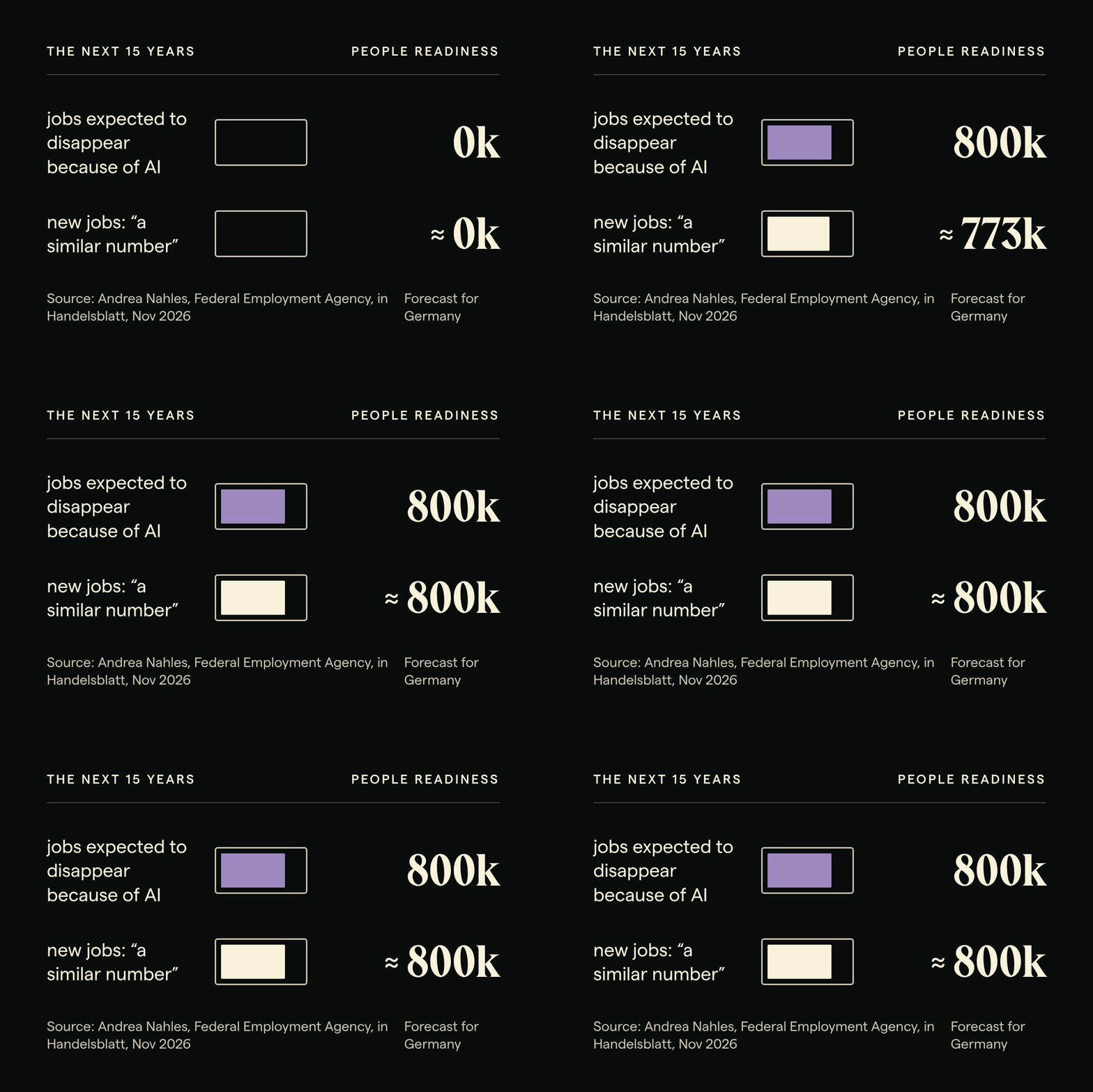
The wider numbers point the same way. In Germany, Andrea Nahles, head of the Federal Employment Agency, expects around 800,000 jobs to disappear because of AI over the next 15 years, with a similar number of new ones created. Analytical roles in banking and insurance are among the most exposed.
Side by side, this describes an unusual assignment. The managers asked to make AI work in their teams are leading a change that puts their own role in question. Few rollout plans account for that. It is also where adoption is decided.
The decision takes an hour. The work takes longer.
The AI decision itself is usually quick. A board approves the roadmap, the budget is released, the slides are good. Some firms make it very concrete. A&O Shearman, the FT reports, is investing $1.1bn in AI and has asked every practice area to commit at least 3% of billable time to building AI tools.
That is a serious commitment, and it is the kind of decision a board can make: a budget and a target. What a budget cannot decide is whether a team under deadline pressure actually changes how it works. That happens on a Tuesday afternoon, in a team meeting no board member attends, led by a manager who is still waiting for answers about her own job.
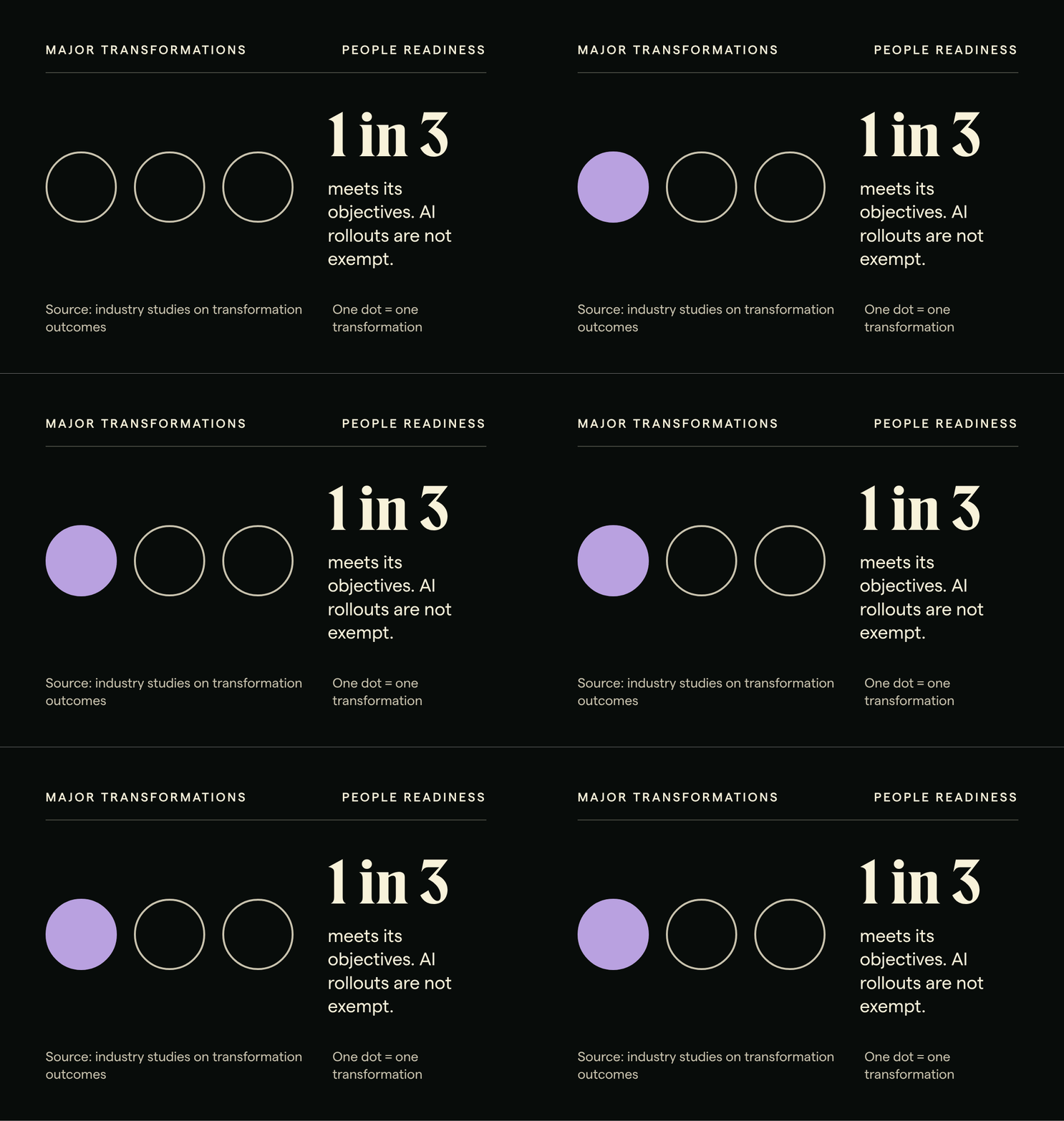
The track record argues for some humility. Roughly one in three major transformations meets its objectives, and there is little reason to think AI rollouts are exempt because the technology is new. Tools change quickly. Working habits change at the pace of the people who hold them.
What slow adoption usually looks like
When adoption lags, the explanation offered is usually reluctance: cautious managers, teams too attached to the old way of working.
Up close, the pattern tends to look different. The team workshop on the new tool is postponed twice because the quarter-end close comes first. An analyst keeps the old spreadsheet open next to the new tool, just in case. At a town hall, someone asks what happens to their role, and the answer is a slide about opportunity.
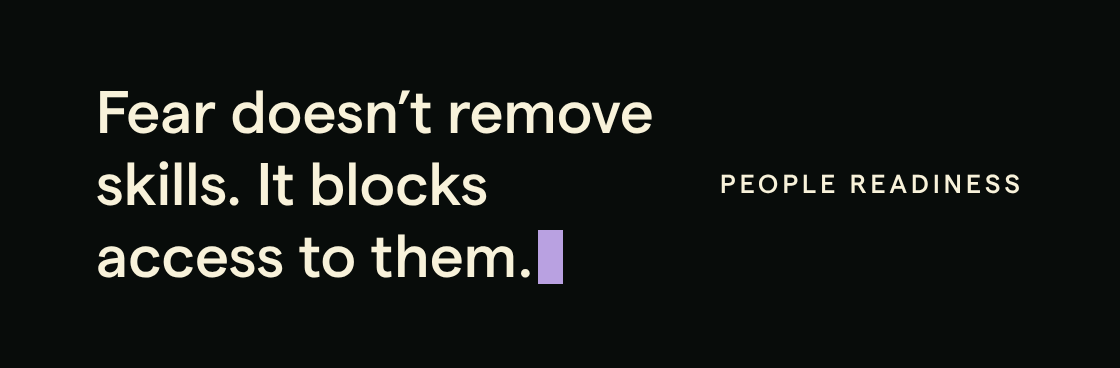
None of this means people cannot learn a new tool. Most managers can. Most teams can redesign a process. What changes under pressure is access to what they already know how to do. Uncertainty about one's own role, a calendar that holds the old work and the new, a strategy nobody has explained in practical terms: each of these draws attention away from the work itself.
For middle managers, that pressure comes twice. They are asked to absorb the change and to lead others through it at the same time, with less information than the people above them and more exposure than the people below.
Where the risk actually sits
That shifts where leaders should look. The signals that matter rarely show up in an adoption dashboard. They show up in a few plain questions about the managers in the middle:
- Do they understand what changes for their own team in the next three months, not just the vision?
- Where is uncertainty about roles highest? A team whose manager expects their own role to shrink needs support more than another round of communication.
- How many changes is each team working through at once? An AI pilot running alongside a reorganization and a cost program is a different situation from an AI pilot alone.
- Is the trend moving? Pressure usually shows in a team weeks before it shows in missed milestones or resignations.
These are not soft questions. The answers decide whether the investment in tools turns into results.
A decision and a capacity
An AI strategy is a decision, and boards are good at making decisions. Using AI well under pressure is a matter of capacity, and that capacity sits in the middle of the organization, with the people who are asked to change the most while being told the least.
The roadmap is written at the top. Whether it works is decided one floor down.
Sources:
- Clark, P. "AI is coming for managers' headcount." Financial Times, 2026. AI is starting to reduce the number of managers companies need, as flatter structures arrive with AI rollouts. https://www.ft.com/content/c1af5834-e9ee-411f-ba57-9af758ac6682
- Lederer, D. "Künstliche Intelligenz: Wie Führungskräfte Teams trotz eigener Zweifel motivieren." DER SPIEGEL Karriere, November 9, 2026. A department head is asked to motivate her team for an AI initiative while she has doubts of her own. https://www.spiegel.de/karriere/kuenstliche-intelligenz-wie-fuehrungskraefte-teams-trotz-eigener-zweifel-motivieren-a-9b9b541b-adf2-4a99-bed8-a4be6804b6bb
- DER SPIEGEL. "Arbeitsagentur-Chefin Nahles rechnet mit Verlust von 800.000 Jobs durch KI." November 10, 2026. Around 800,000 jobs are expected to disappear because of AI over the next 15 years, with a similar number of new ones created. https://www.spiegel.de/wirtschaft/unternehmen/kuenstliche-intelligenz-andrea-nahles-rechnet-mit-verlust-von-800-000-jobs-a-64556960-bdcf-4d85-becc-93ef14bb937e
- Financial Times. "A&O Shearman invests $1.1bn in AI." 2026. Every practice area must commit at least 3% of billable time to building AI tools. https://www.ft.com/content/b832654a-79d1-4db0-9de8-d1a65251539d