_2026@2x.png?width=50&height=50&name=TPRC-Signet-(Deep)_2026@2x.png "TPRC-Signet-(Deep)_2026@2x")
_2026@2x.png?width=50&height=50&name=TPRC-Signet-(Pebble)_2026@2x.png)
TPRC®
PE & M&A.
You diligence the financials, the legal structure, the technology, and the leadership. The variable that destroys most of the value post-close is not on the checklist. That is the readiness gap. We measure and close it, before, during, or after the transaction.
What you check off.
- Financial due diligence and quality of earnings.QoE report. Adjustments quantified.
- Legal and regulatory review.Counsel signed off. Risks documented.
- Commercial diligence and market sizing.TAM defended. Win-rate validated.
- Technology and operational diligence.Stack reviewed. Ops mapped.
- Leadership assessment and key person risk.Top team mapped. Retention modeled.
- Integration plan and value creation thesis.Synergies modeled. Sequencing set.
What you expect.
The thesis delivered on schedule.
Synergies captured in the first twelve months.
Senior people retained through the transition.
The acquired team operating against the new plan.
Multiple expansion at exit. A returns profile the LPs were promised.
The thesis. The synergies. The returns the LPs were promised.
What statistically arrives.
of M&A deals fail to meet objectives, with over half of organizations losing key talent at the same or higher rate than non-critical talent.
of M&A practitioners who experienced a failed deal point to problems in the integration as the primary cause.
The gap between what was diligenced and what arrives is not a margin. It is a pattern.
The readiness gap.
The gap is the difference between the value committed to in the thesis and the value that arrives post-close. It forms in the space between transaction and integration, where one variable is not measured: whether the people on both sides, the acquired and the acquirer, are in a position to deliver the plan being built across them. Pre-close as part of due diligence. Post-close as the integration unfolds.
Kickoff · funded, staffed, deployed, aligned
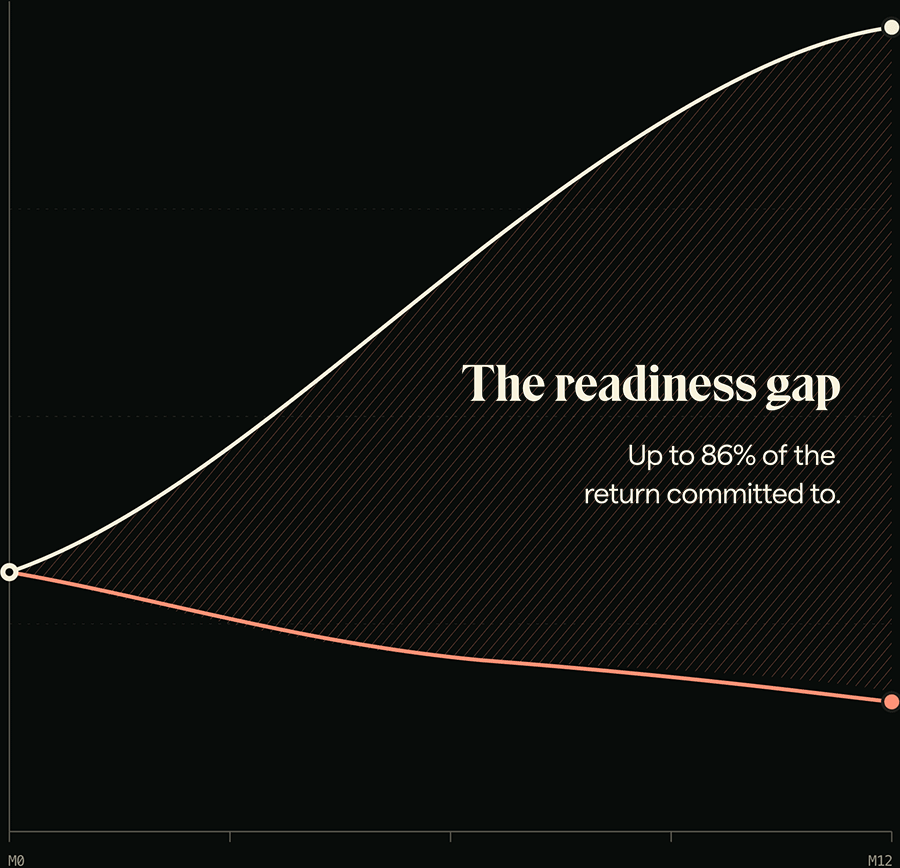
The diligence was rigorous. The thesis did not arrive. The variable nobody ran a number against: whether both sides could deliver the plan built across them.
Three moves. One framework.
A people risk profile before the deal closes.
Continuous tracking through integration.
A measured shift at Day 90.
“ When the last deal underperformed its thesis, how often was people readiness a factor? And what did your due diligence process tell you about that risk in advance? ”
Start with a conversation.
Thirty minutes. We listen to what is happening in your portfolio or your next deal, place it against the readiness framework, and tell you what a diagnostic would surface.