TPRC®
Practical application
How people readiness gets measured and built inside your organization. The actual process, from first measurement to visible shift.
Every engagement follows the same rhythm.
Not reports that sit in a drawer. Actionable data that shapes decisions in real time.
The cycle, step by step.
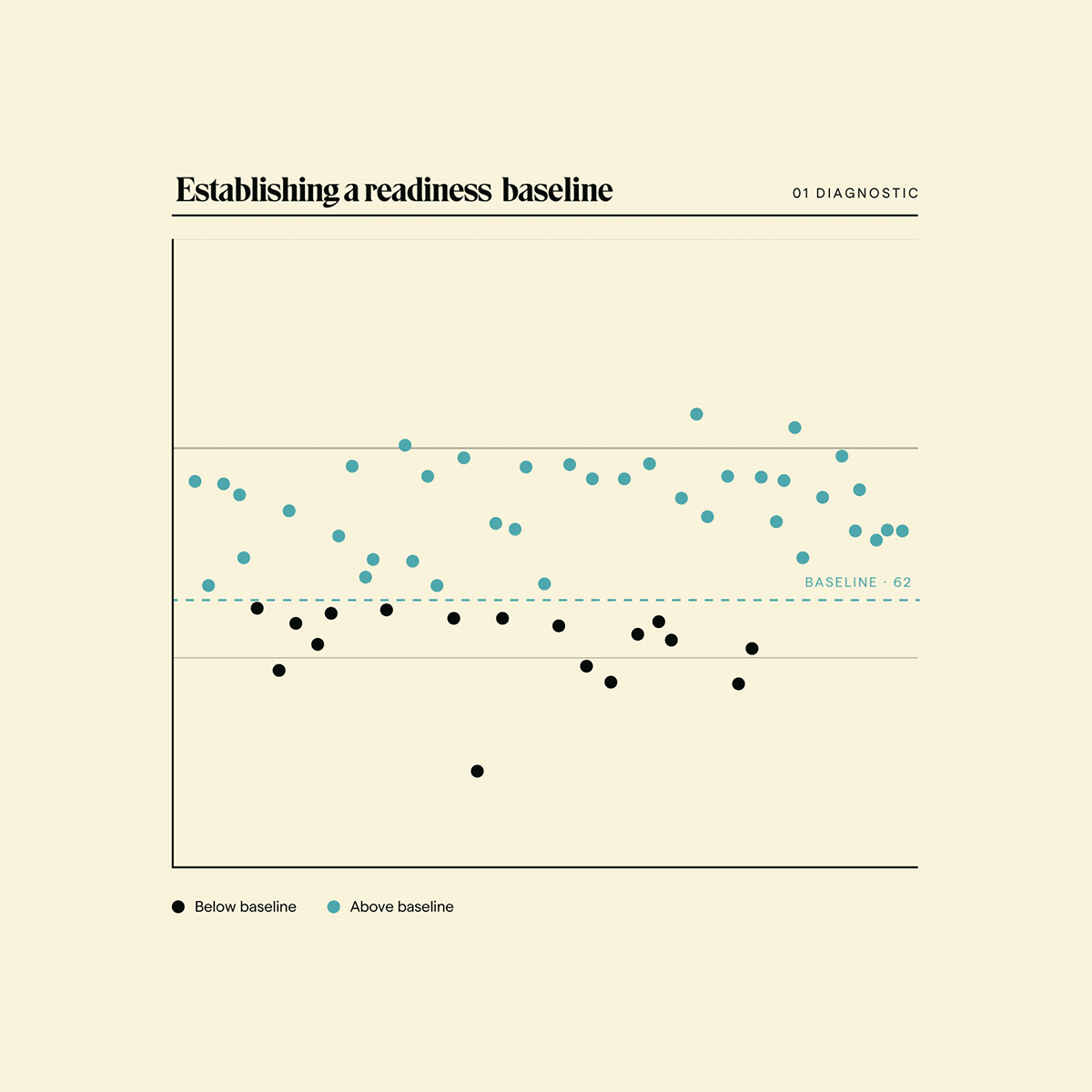
Diagnostic
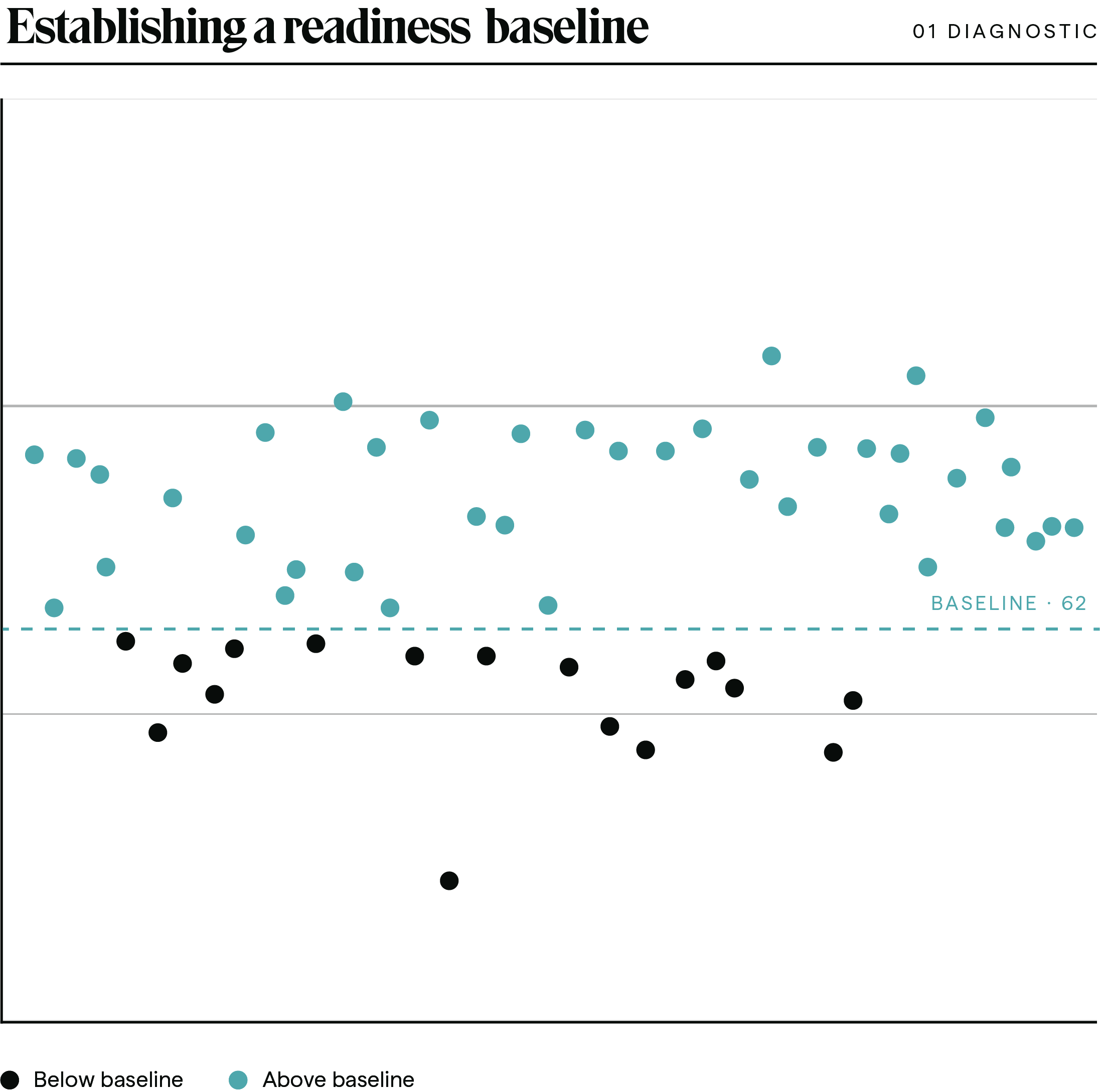
Every employee on the team or project completes the people readiness assessment. Results are summarized at the team and organizational level to establish the readiness baseline.
A readiness score at the team and organizational level. Individual profiles stay private to the person. Leadership receives a full debrief with the baseline data and an initial gap analysis.
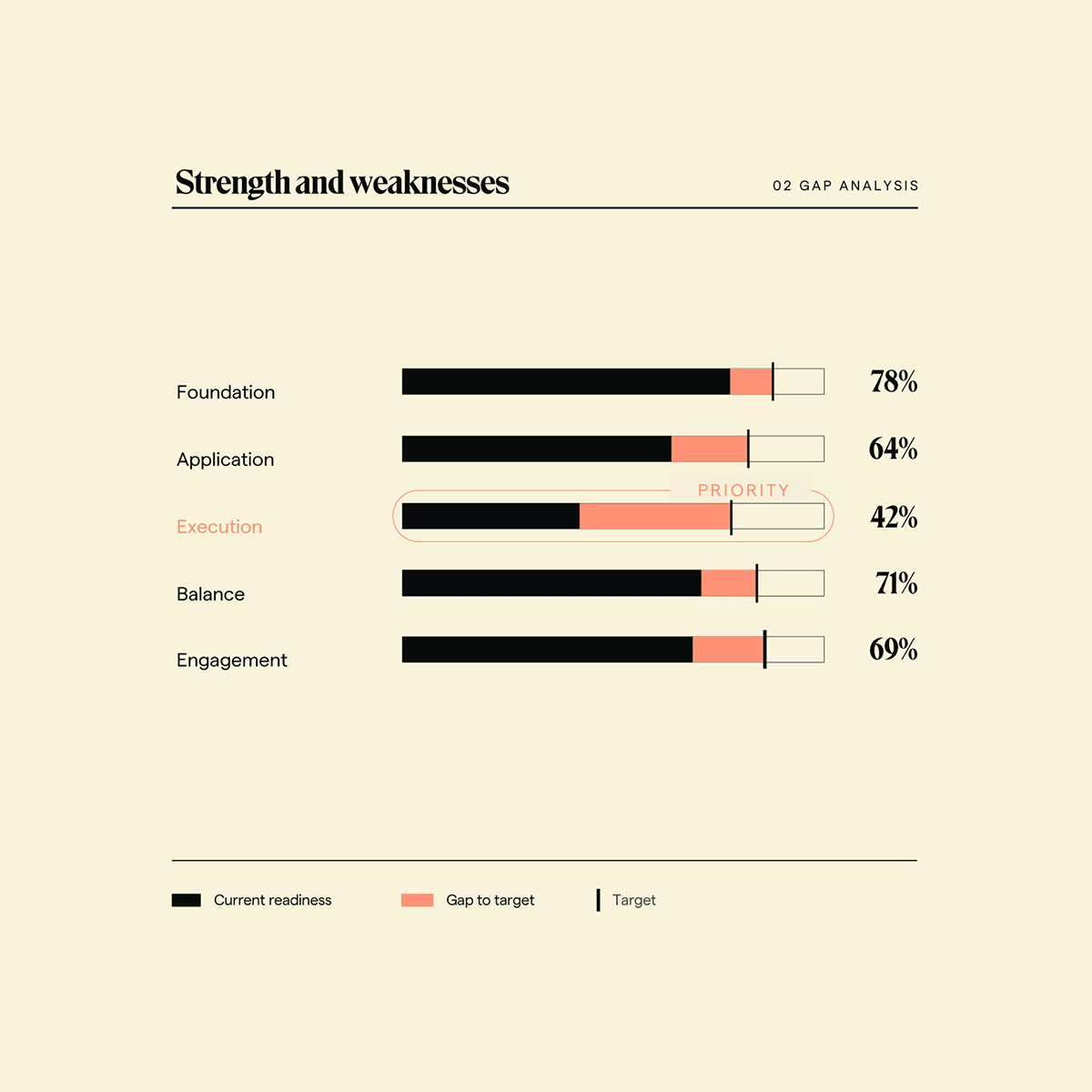
Gap analysis
We walk leadership through the results. Together we identify where readiness is lowest and where building it will have the most impact on the current initiative. Development priorities are set on what the data shows, not on assumptions.
A development plan targeted to existing gaps. Clear priorities for the next ten weeks.
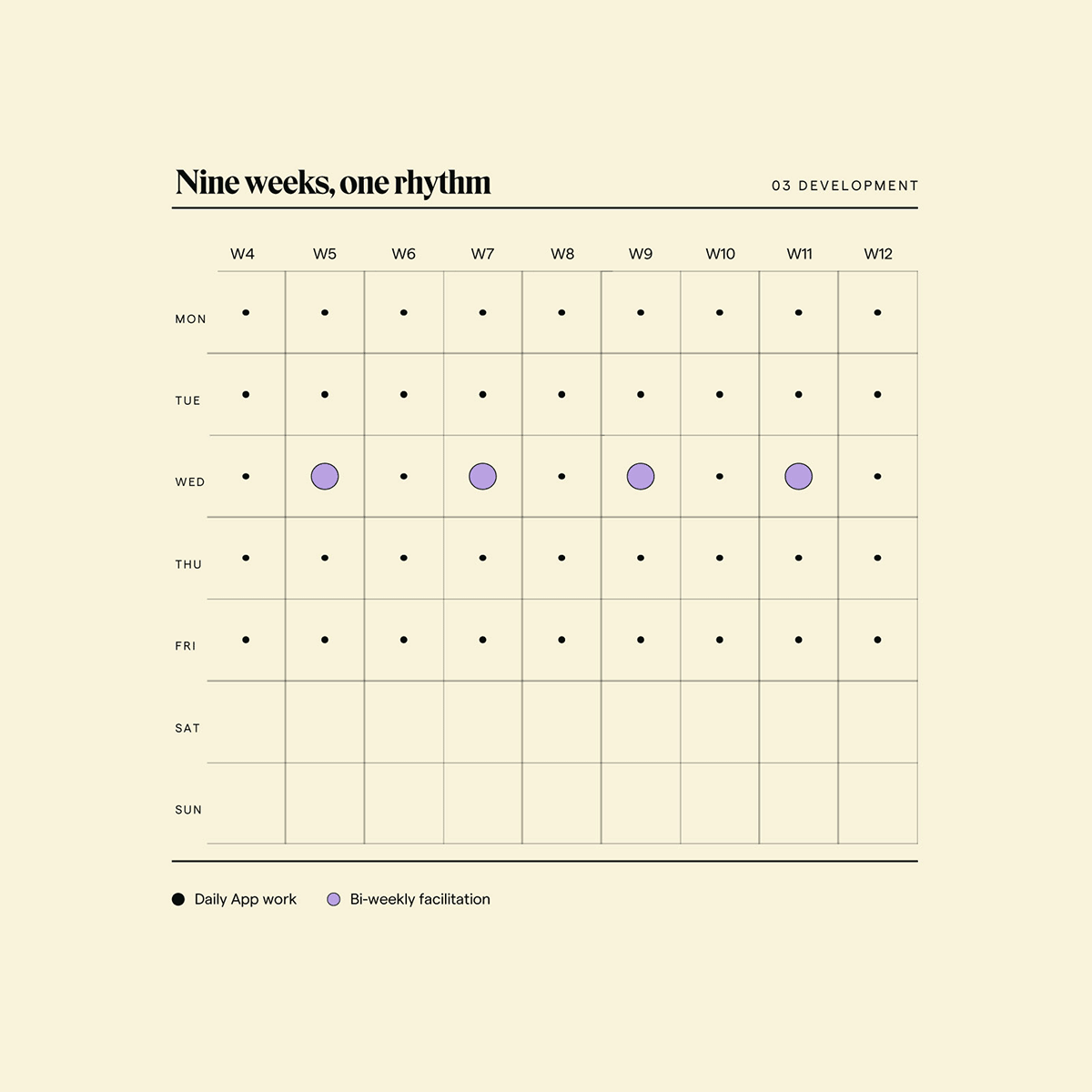
Development
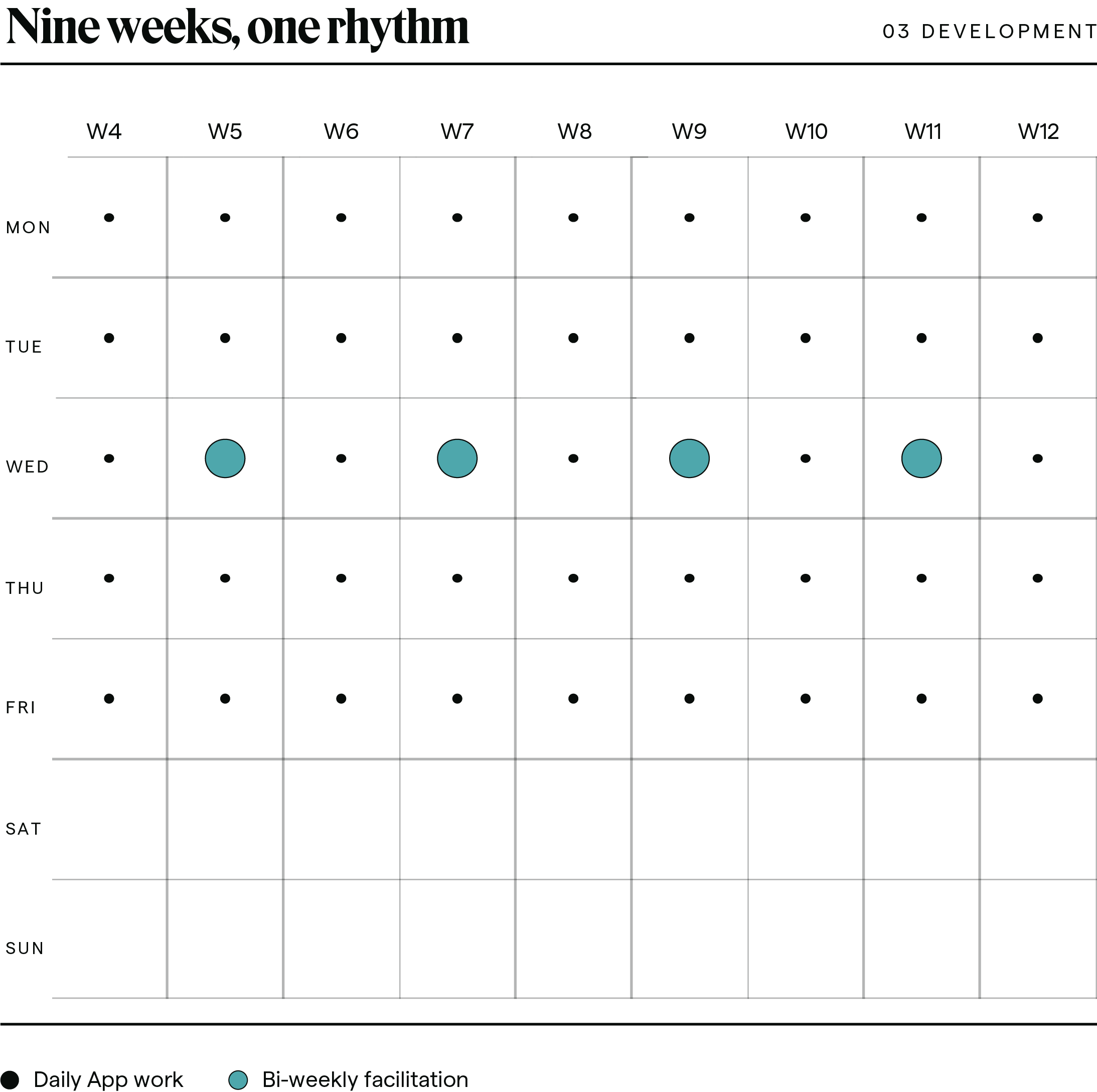
Employees complete a short daily check-in that takes five to ten minutes. Every two weeks, a facilitated group session brings the team together to work on the specific areas the diagnostic identified. Our coaches track progress across all three instruments.
Live trend data you can check at any time. A facilitation report after each group session. Early signals when a team or individual is losing capacity.
Reassessment
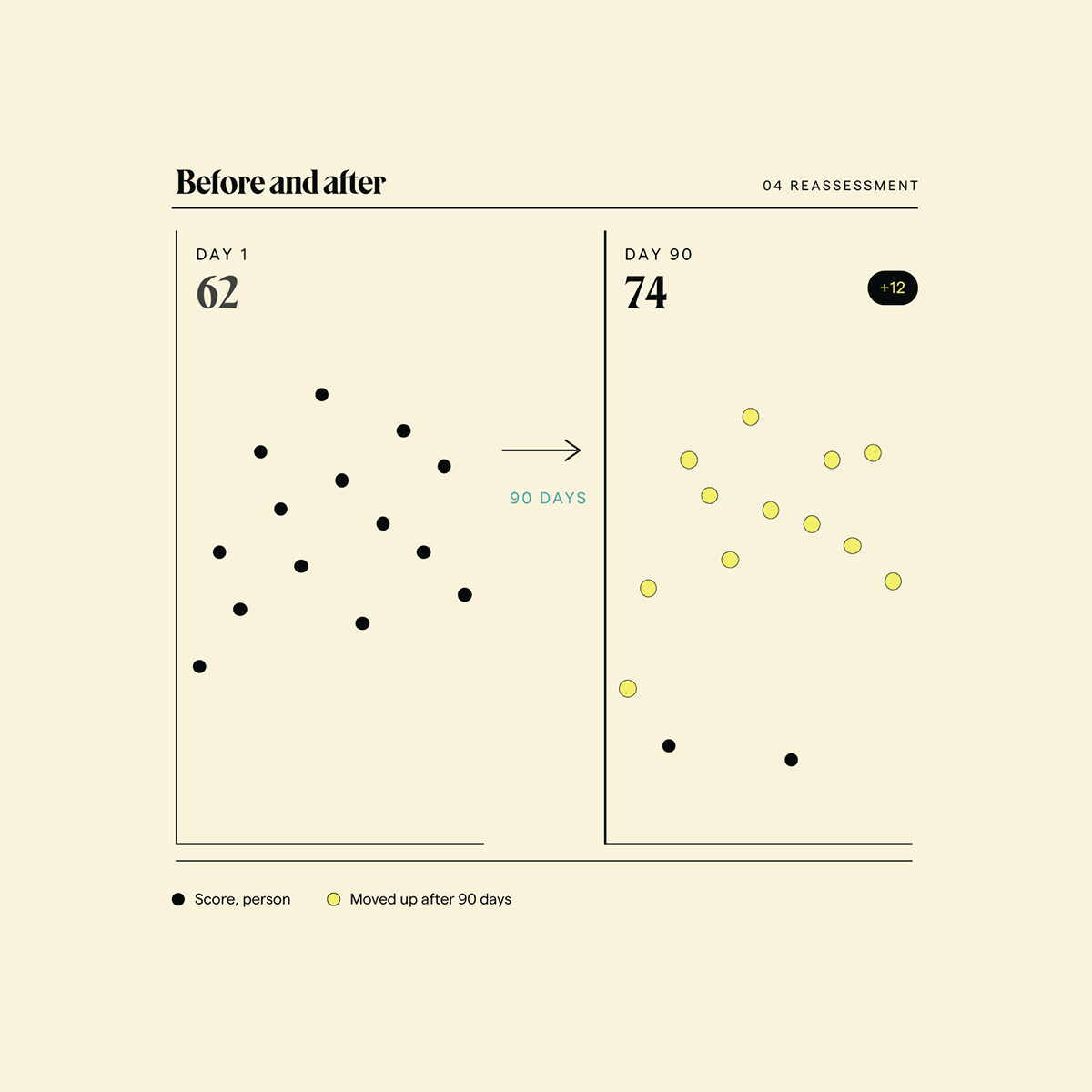
The same assessment from Day 1, repeated. Same people, same instrument. A new baseline is established. The events that shaped the cycle, including strategy shifts, team changes, and external pressure, are mapped against the readiness curve so leadership sees not just where the score moved, but what moved it.
A clear before-and-after picture. The numbers either moved or they did not. Leadership receives a full results debrief.
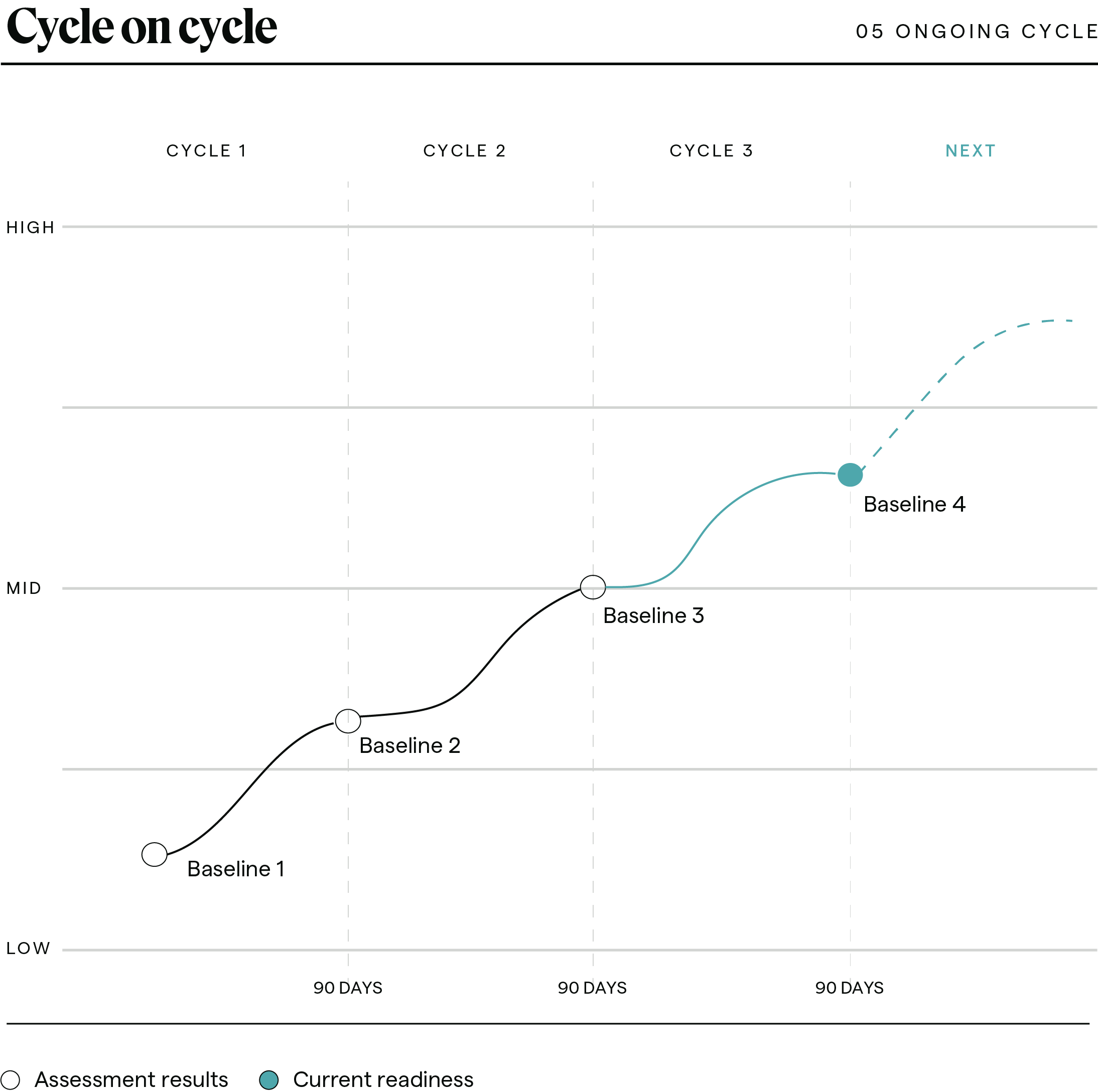
Ongoing cycle
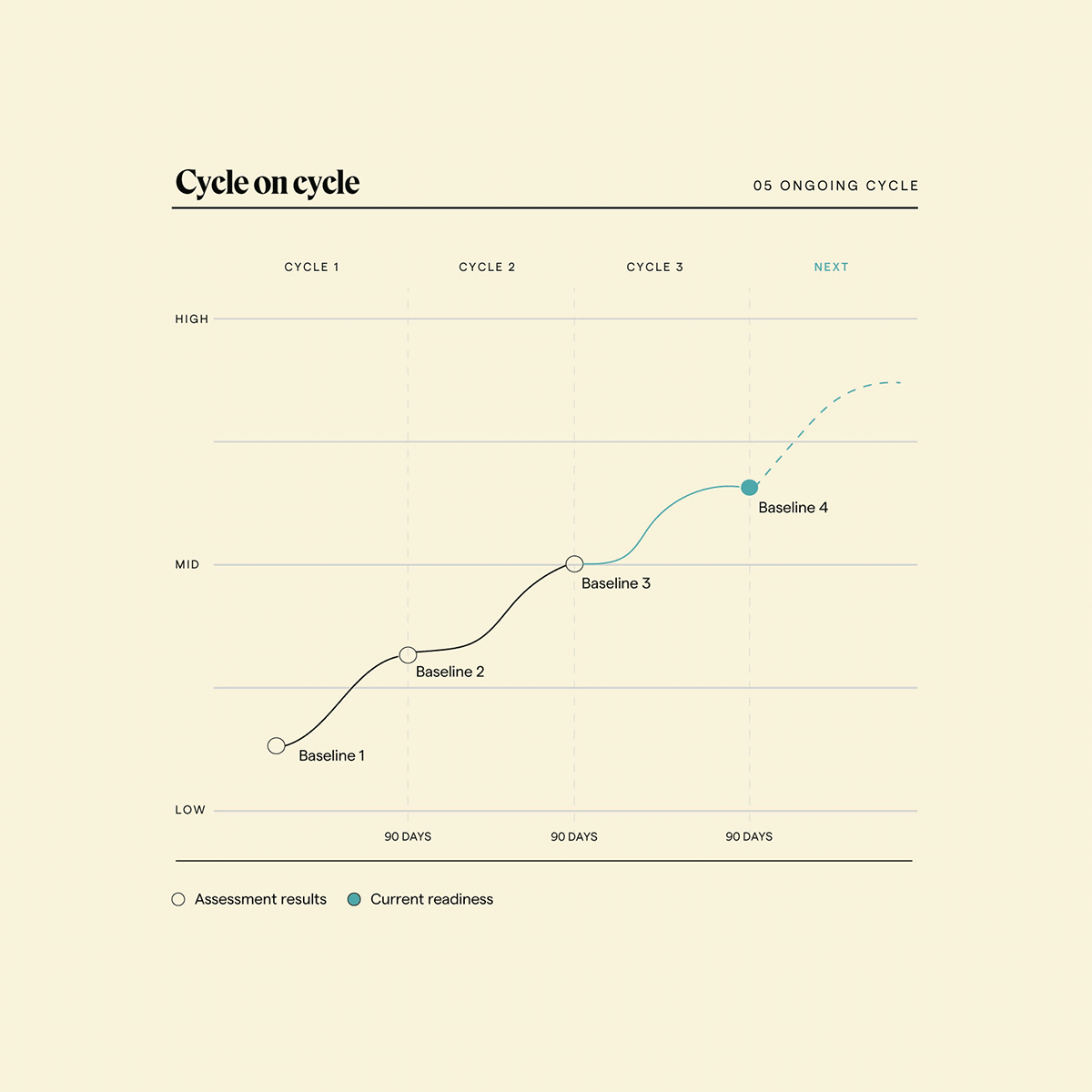
The cycle starts again. New priorities. New baseline. Readiness becomes a continuous metric, not a one-time project.
A score that stays current as the work changes. A team that keeps building. Data that compounds across cycles.
Same rhythm. Same investment each cycle.
Diagnostic
Every employee on the team or project completes the people readiness assessment. Results are summarized at the team and organizational level to establish the readiness baseline.
A readiness score at the team and organizational level. Individual profiles stay private to the person. Leadership receives a full debrief with the baseline data and an initial gap analysis.
From your people: 10 minutes, once.
From leadership: one 60-minute debrief.
Diagnostic
Every employee on the team or project completes the people readiness assessment. Results are summarized at the team and organizational level to establish the readiness baseline.
A readiness score at the team and organizational level. Individual profiles stay private to the person. Leadership receives a full debrief with the baseline data and an initial gap analysis.
From your people: 10 minutes, once.
From leadership: one 60-minute debrief.
Gap analysis
We walk leadership through the results. Together we identify where readiness is lowest and where building it will have the most impact on the current initiative. Development priorities are set on what the data shows, not on assumptions.
A development plan targeted to existing gaps. Clear priorities for the next ten weeks.
From your people: none.
From leadership: one 60-minute session.
Development
Employees complete a short daily check-in that takes five to ten minutes. Every two weeks, a facilitated group session brings the team together to work on the specific areas the diagnostic identified. Our coaches track progress across all three instruments.
Live trend data you can check at any time. A facilitation report after each group session. Early signals when a team or individual is losing capacity.
From your people: 5–10 minutes daily plus 45 minutes every two weeks. From leadership: one 10-minute progress update per month, by email.
Reassessment
The same assessment from Day 1, repeated. Same people, same instrument. A new baseline is established. The events that shaped the cycle, including strategy shifts, team changes, and external pressure, are mapped against the readiness curve so leadership sees not just where the score moved, but what moved it.
A clear before-and-after picture. The numbers either moved or they did not. Leadership receives a full results debrief.
From your people: 10 minutes, once.
From leadership: one 60-minute debrief.
Ongoing cycle
The cycle starts again. New priorities. New baseline. Readiness becomes a continuous metric, not a one-time project.
A score that stays current as the work changes. A team that keeps building. Data that compounds across cycles.
Same rhythm. Same investment each cycle.
What leadership sees at every stage.
Baseline before the change begins.
Live tracking as demands shift.
Reassessment at Day 90.
Human context instruments miss.

A real engagement, in detail.
A US tech company.
The research underneath this.
The two dimensions flagged in this case map onto established organizational research.
Interpersonal Effectiveness tracks closely with what Amy Edmondson (Harvard) defines as psychological safety: the shared sense that a team is safe for interpersonal risk. Where it is low, teams show surface compliance and private withdrawal, the pattern observed here.
Growth Mindset draws on Carol Dweck's work (Stanford) on implicit theories of ability. Where it is low, people under-engage with skill demands that feel exposing, because the cost of visible failure outweighs the cost of quiet non-adoption.
Edgar Schein's refinement of the Lewin change model adds the connecting mechanism: learning holds only when the conditions to learn are stronger than the anxiety of being seen learning, which is why Schein argues for lowering learning anxiety rather than raising the pressure to change.
A US-based technology and innovation company has completed a twelve-month digital platform rollout. The system was live across the organization. Training had been delivered to every department. Twelve months in, adoption was sitting at 30 percent. In leadership reviews, the team consistently described the rollout as on track. In day-to-day practice, the platform was being used in fragments, and the work it was meant to enable was not happening.
The standard response to a moment like this is to add more communication, more training, or more leadership pressure. Each of these treats the symptom, low adoption, as the problem to solve. The readiness framework starts from a different question: is the team in a position to absorb what is being asked of them, and what is in the way, fears, structural obstacles, or both, on top of what they are already carrying?
What the diagnostic surfaced
Across four dimensions and three layers, two scores stood out at baseline.
effectiveness
mindset
Both well below the threshold the framework defines as adequate for absorbing significant new ways of working. The data was pointing at something the leadership team had not been able to name: the team was not resisting the platform itself. They were resisting what the platform represented to them. New ways of working they had not yet tested. New skills being asked of them in public. The unspoken question of whether the system was there to help them do their work, or to do parts of it for them.
That is what the readiness gap looked like in practice. Not unwillingness. Not bandwidth. A team that had not been given the conditions to work through what the change meant for them, and who quietly held back until they had.
What the development cycle did
Over the following ten weeks, facilitated group sessions and continuous pulse tracking were targeted to the two dimensions the diagnostic had flagged. The work was not about the platform. It was about how the team communicated under pressure, how they handled uncertainty out loud, and how they could surface what the change actually meant to them without it costing them standing.
Daily individual check-ins tracked whether the development was holding. Facilitation reports captured what the data could not, the patterns of who was speaking up, who was pulling back, and where the unspoken concerns were sitting.
There was no additional training on the platform itself. The platform had not been the problem.
What the reassessment showed at Day 90
Adoption moved because readiness moved.
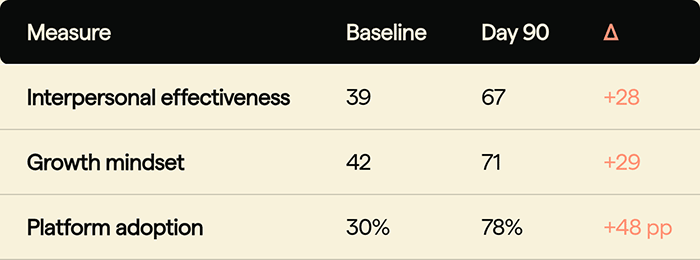
| Measure | Baseline | Day 90 | Δ |
|---|---|---|---|
| Interpersonal effectiveness | 39 | 67 | +28 |
| Growth mindset | 42 | 71 | +29 |
| Platform adoption | 30% | 78% | +48 pp |
Adoption moved because readiness moved.

What leadership took away
The leadership team's own reflection from the engagement debrief, paraphrased: they had spent twelve months trying to push adoption up. The shift came when they stopped working on the rollout and started working on what the rollout meant to the people carrying it.
That is the difference the readiness framework introduces. It does not replace the rollout, the training, or the strategic plan. It identifies, before the work begins, whether the people are in a position to deliver, and what is sitting between them and the work being asked of them. And it gives leadership the data to act on what it finds.
Individual readiness profiles are visible only to the individual.
Leadership sees team and organizational views, never individual data. Facilitation reports capture group dynamics, never named behavior. The framework builds trust by protecting it, which is also what makes the data honest in the first place.
Built to surface patterns, not to surveil people.
The cycle is the practice. The score is the proof.
Download a sample 90-day engagement outline.
Start the conversation.
Thirty minutes. We listen to what is happening in your organization, place it against the readiness framework, and tell you what a diagnostic would surface.
Read the case studies.
Real engagements, with the diagnostic data, the development cycle, and what shifted at Day 90. Specific to industry, size, and stage.
Explore the resources.
Papers, frameworks, and field notes on people readiness. The full library, available without a form.
_2026@2x.png?width=50&height=50&name=TPRC-Signet-(Deep)_2026@2x.png)